Certificate or permit required at all time!
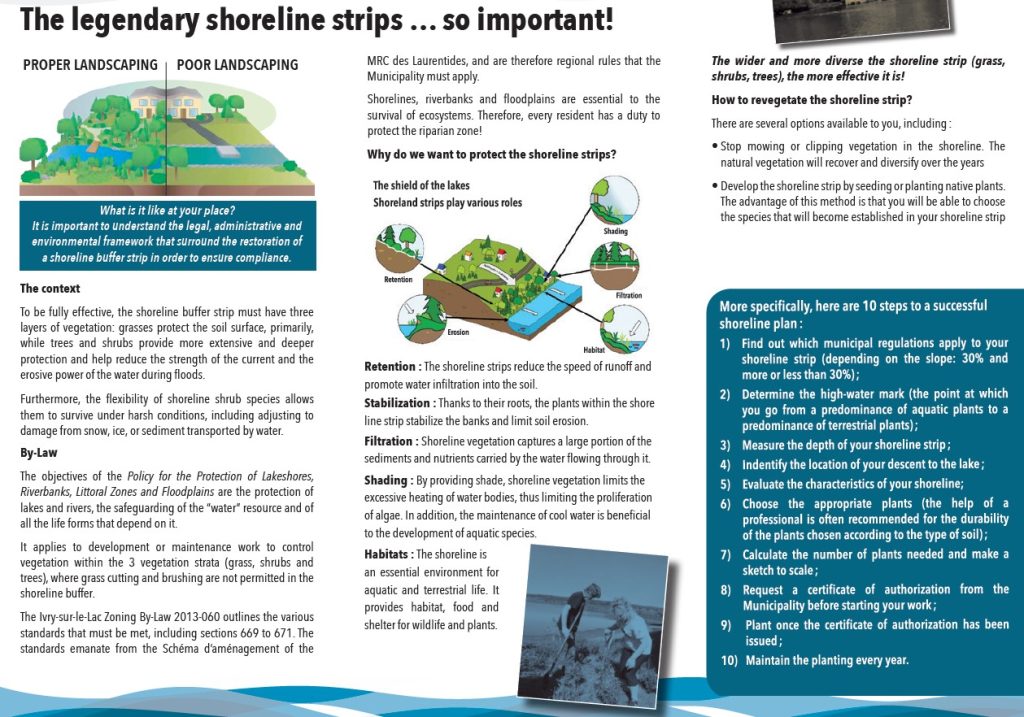
It is widely recognized that renovations or the construction of new structures on the grounds require a building permit. Well, did you know it’s the same for docks?
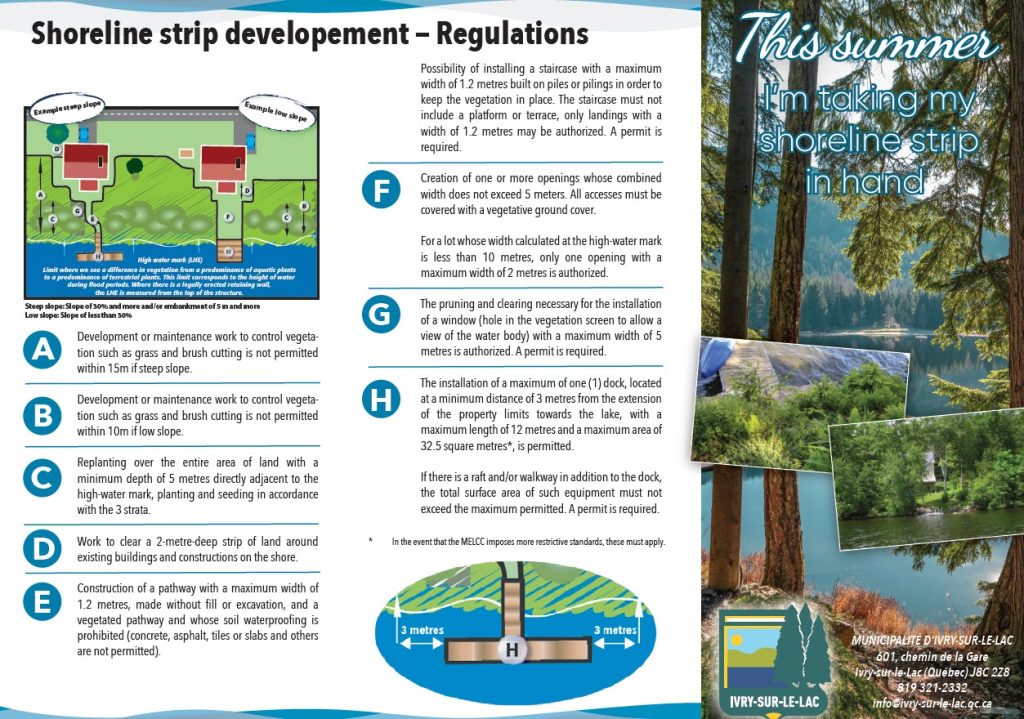
Please note that a permit is always required for the installation of docks, rafts, trampolines, boat ramps and walkways, and for any types of renovation, large or small. A change in the size or location of a dock could result in it not conforming to the regulations in effect, it is also required to obtain a permit beforehand, so that the changes can be validated and ensure that they respect the regulations.
An application for a permit provided by the Municipality must be completed and sent to the Municipality for approval. It is also essential that the application be complete, which will speed up the process of issuing permits, in particular by submitting a detailed plan of the dock that includes its dimensions, its type of foundation and the type of wood used. We also need to know exactly where the boundary between your property and the neighbor’s is situated. Without this limit, it is impossible for the head of urban planning to validate compliance with Section 159 of the zoning by-law # 2013-060 and it will be impossible for him to issue a permit prior to obtaining this important information. Unfortunately, the superimposition of satellite images on the RCM’s graphic matrix is not a precise way to validate the information because it is very imprecise.
Zoning By-law 2013-060 – Docks Section
The following standards currently apply throughout the territory of Ivry-sur-le-Lac:
- If there is a raft or a launching ramp in addition to the dock, the sum of the areas of all these accessory equipments must not exceed 32.5m2;
- Where a dock is equipped with a gangway, the area and length of the gangway shall be included in the calculation of the maximum size and length of 32.5m2;
- The maximum size of a dock shall be 32.5m2 and the maximum length shall be 12 metres;
All docks shall be located at a minimum distance of 3 metres from the waterward extension of the side lot lines;
- Floating trampolines are treated in our by-law as rafts and therefore a permit is required for their installation, they cannot have a surface area of more than 13.4m2 and their surface area must be included in the maximum dock area of 32.5m2;
- For the construction of structures in the shoreline or on the littoral (including docks, gangways, rafts and launching ramps) only non-polluting materials are authorized.
It is also important to ensure that the materials are not harmful to the environment, so avoid any polluting materials:
POLLUTING MATERIALS (FOR ANY STRUCTURE IN THE SHORELINE OR LITTORAL ZONE)
Means any metal not covered with a protective impermeable coating and susceptible to corrosion by contact with water or otherwise, as well as any concrete, cement or aggregate susceptible to disintegration by the combined action of water and wind, and any material of the same nature that may be harmful to the environment. Treated wood, used tires, toxic stains, and salvaged or corrosive materials that may release a contaminant are prohibited.
If the use of treated wood cannot be avoided, care must be taken to:
- select wood treated with preservatives registered in Canada under the Pest Control Products Act for use in fresh, brackish or salt water, as appropriate;
- use factory pressure treated wood that has completed the fastening process;
- follow the manufacturer’s instructions;
- use these materials on a limited basis;
- carve wood pieces in a terrestrial environment;
Every permit implies a visit by the inspector who will visit the site at the end of the work to confirm that the location and size of the structures installed respect the information presented in the permit application. In the event that, during the course of the work for which a permit was issued, a person wishes to modify the authorized plans and specifications, he or she must notify the person in charge of the Municipality’s urban planning department as soon as possible, as it is certain that the latter will note this during his or her visit.
For more information on this topic, please contact the Head of Urban Planning, Roads and the Environment by email or by phone at extension 3702.
Ministry of the Environment and the Fight against Climate Change, MELCC
On March 1st, the transitional regularity framework for the management of shorelines, littoral zones and flood-prone areas came into effect. This framework was put in place to ensure the safety of the population in the face of flooding and the protection of waterways. This transitional regime governs work permitted along shorelines, littoral zones, and flood risk areas. It supersedes municipal by-laws that set standards for such work.
As our municipal by-law is more permissive, some permit or certificate applications may require additional authorization(s) from the MELCC, and possibly the Ministry of Forests, Wildlife and Parks, before the municipality is able to issue your permit. If you are planning projects on the shoreline or littoral (concerning your boathouse, dock, or other) we strongly suggest that you start the process now to obtain all the necessary authorizations that will allow you to obtain your municipal permit or certificate before the work begins.
For example, the maximum area permitted without authorization from the MELCC is 20 square meters.
This means that the municipality, despite its less restrictive regulations, cannot issue a permit for a dock (and/or raft) with an area of more than 20 square meters without first obtaining authorization from the MELCC.
https://www.quebec.ca/en/government/ministere/environnement/contact-us